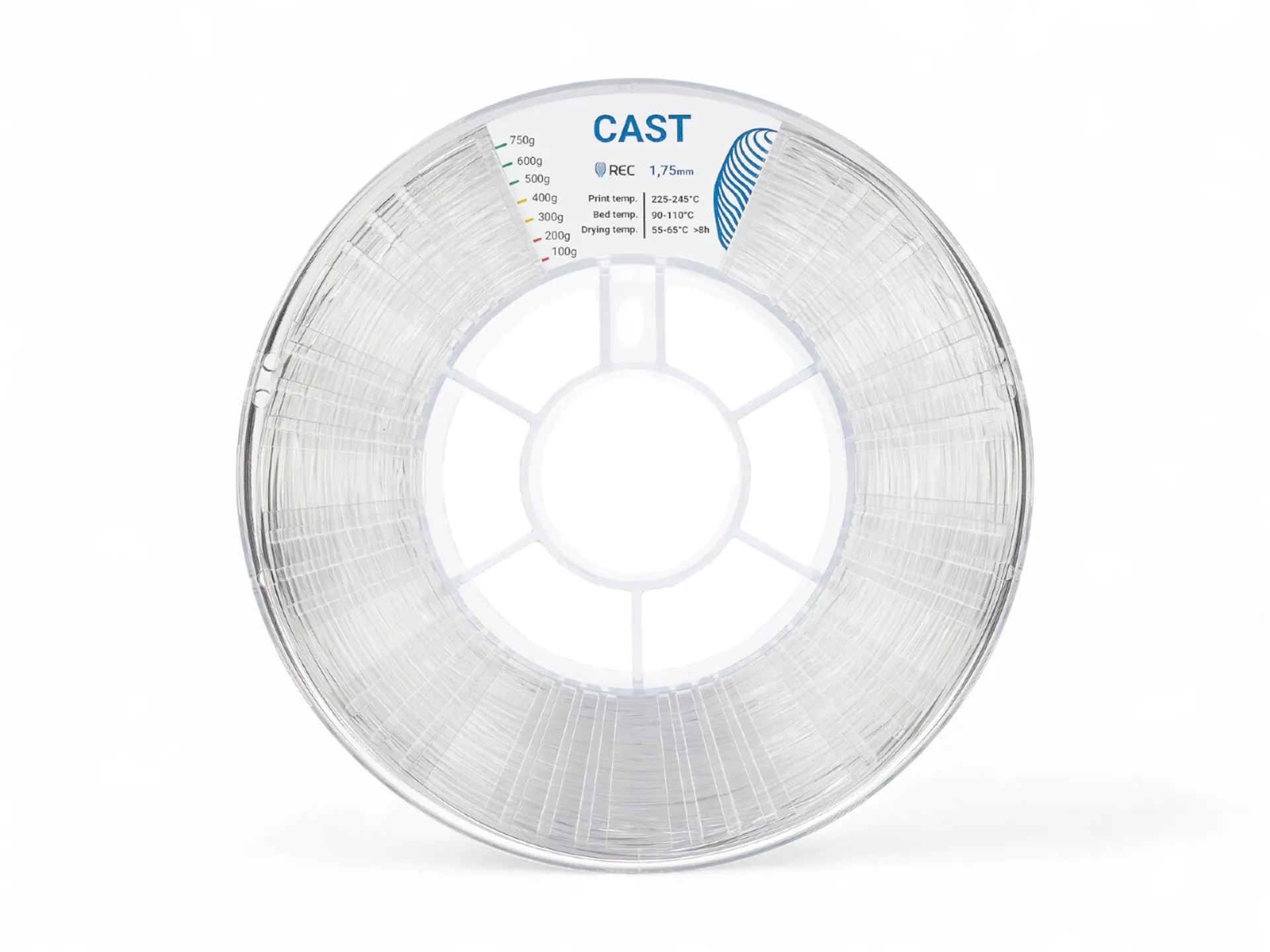
REC CAST is a special material based on polymethylmethacrylate with the addition of special plasticizers. The material is prepared specifically for printing objects used in casting according to burnt models.
During the development of this material, we conducted tests at the Moscow State University Research Center. The results of thermogravimetric analysis in a dynamic air atmosphere showed that the mass fraction of ash is less than 0.1% of the mass of the printed object when it is burned at ~405°C.
Thus, this material has an extremely low ash content, which makes it an ideal material for creating burnt master models.
Previously, everyone who needed to get a master model for burning was forced to sharpen them on plexiglass and polystyrene cutters or order expensive 3D printing from burned photopolymers. Now any owner of an FDM 3D printer can make a master model from REC CAST and turn to the foundry to manufacture the necessary part, without spending significant funds.
Printing REC CAST is a little more difficult than printing ABS plastic, with proper skill, you can achieve amazing results.
During the development of this material, we conducted tests at the Moscow State University Research Center. The results of thermogravimetric analysis in a dynamic air atmosphere showed that the mass fraction of ash is less than 0.1% of the mass of the printed object when it is burned at ~405°C.
Thus, this material has an extremely low ash content, which makes it an ideal material for creating burnt master models.
Previously, everyone who needed to get a master model for burning was forced to sharpen them on plexiglass and polystyrene cutters or order expensive 3D printing from burned photopolymers. Now any owner of an FDM 3D printer can make a master model from REC CAST and turn to the foundry to manufacture the necessary part, without spending significant funds.
Printing REC CAST is a little more difficult than printing ABS plastic, with proper skill, you can achieve amazing results.
| Print Settings | |
| Nozzle temperature | 225-245°C |
| Table temperature | 90-110°C |
| Blowing | not recommended |
| Min. nozzle diameter | 0.2 mm |
- Общие характеристики
Механические характеристикиПлотность 1,18 г/см3 Температура эксплуатации от -10°С до +80°С Температура размягчения ~ 113°C Страна производитель Россия
Электрические характеристикиУдарная вязкость по Шарпи н/д Прочность при растяжении вдоль слоев 72 МПа Модуль упругости при растяжении вдоль слоев н/д Прочность на изгиб 110 МПа Модуль упругости на изгиб н/д Максимальная нагрузка на изгиб н/д Прочность при растяжении поперек слоев н/д Модуль упругости при растяжении поперек слоев н/д Максимальная нагрузка на растяжение н/д Прочность на сжатие н/д Модуль упругости на сжатие н/д Максимальная нагрузка на сжатие н/д Коэффициент удлинения 5% Биоразлагаемость н/д Светопропускаемость 92% Показатель текучести расплава: 1,8 г/10 мин, при 230 °С 3,8кг Прочность при изгибе 2,8 мм/мин. 23°C н/д Твердость (шкала М) 95 Масло-бензостойкость (максимальное изменение формы за 24 часа) н/д Кислородный индекс, %O2 по ГОСТ 21793-76 н/д Массовая доля золы по ГОСТ 15973 н/д
Транспортные характеристикиУдельное электрическое сопротивление на постоянном токе 6,6х1012 ОМ/см Диэлектрическая проницаемость на постоянном токе 3,19 Диэлектрическая проницаемость на частоте 50 кГц 2,88 Тангенс угла диэлектических потерь на частоте 50 кГц 0,0085 Электрическая прочность 18 кВ/мм Габариты упаковки 210х225х70 мм Вес нетто 750 грамм Вес брутто 1.1 кг